

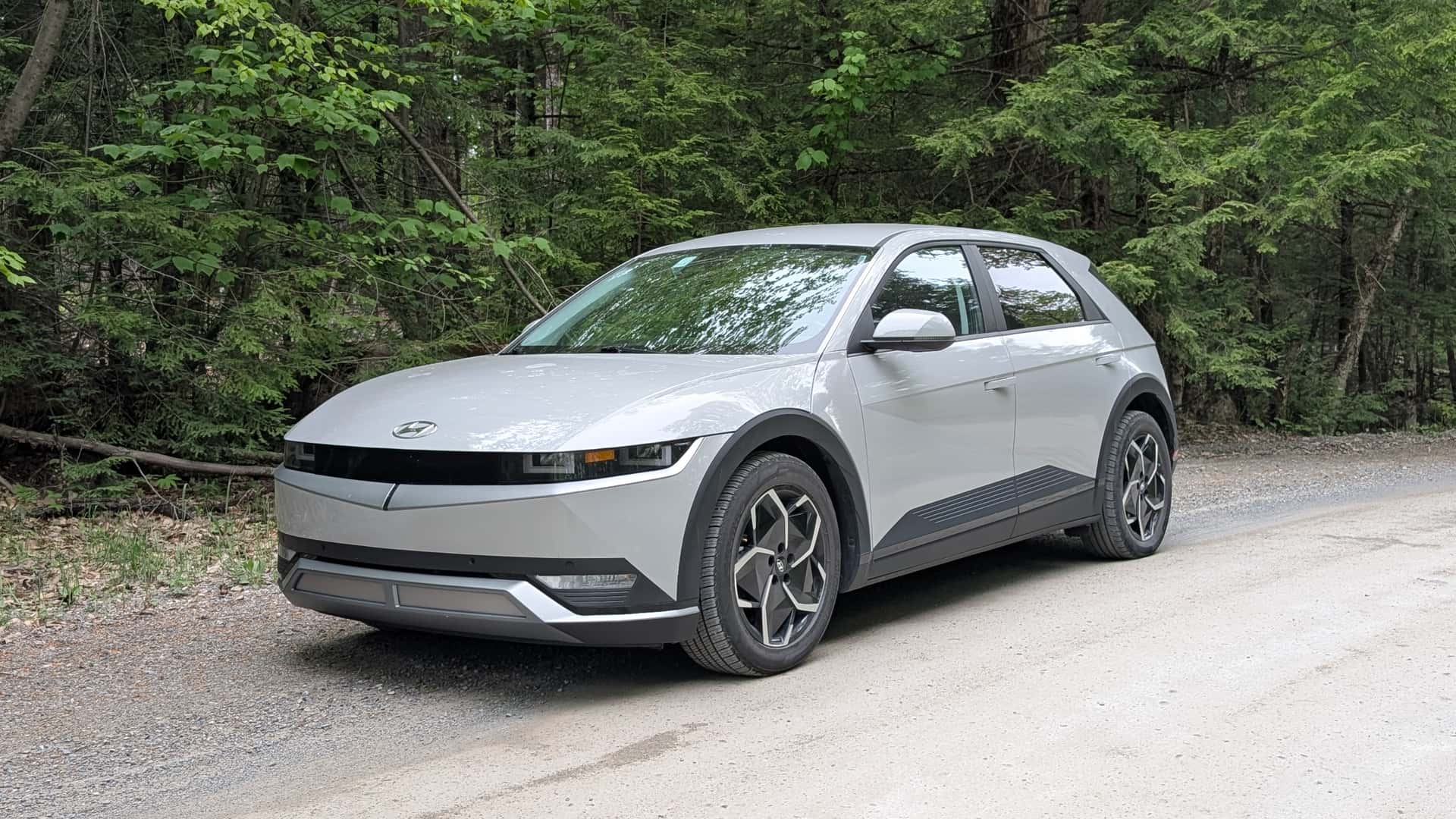
The line at the Avis rental car location in New York City was packed with Memorial Day weekend travelers wearing sunglasses and hats, dragging carry-ons behind them and hoisting backpacks over their shoulders. In the pickup area, employees reversed freshly cleaned SUVs into parking spots one after another, preparing them for long holiday drives out of the city.
My friend and I were headed to Upstate New York to escape the cacophony of the city and spend the weekend around Lake George before hiking in the Adirondacks. Getting there, however, wasn’t easy. Amtrak tickets were sold out for the weekend, Metro-North wasn’t practical for where we were going, and rental-car prices were exorbitant.
Even economy cars like the Chevrolet Spark and Toyota Corolla were either fully booked or absurdly expensive. The cheapest cars available were EVs, with just two options to choose from: the Kia Niro EV or the Hyundai Ioniq 5. Oddly enough, despite being an entire generation apart, they were priced the same. The Ioniq 5 was a no-brainer pick thanks to its faster charging speeds and longer range.

Photo by: Suvrat Kothari
An EV wouldn’t be every traveler’s first choice. But I’ve been around the block and know that finding places to charge in the Northeast isn’t too big a hassle. Plus, with average gas prices in New York hovering over $4.50 per gallon amid the ongoing war in Iran, I was relieved at the thought of avoiding gas stations altogether.
I wasn’t expecting to save much on refueling, since I’d be relying exclusively on public fast-charging stations, which are much more expensive than plugging in at home. But after over 500 miles of driving, I was stunned by how much I had saved by going electric.
As we set out, I was reminded of how awesome the Ioniq 5 is all-around. It’s one of our favorite cars here at InsideEVs. Its latest update with the larger battery pack and the Tesla-style North American Charging Standard (NACS) port made it an Editor’s Choice for last year’s InsideEVs Breakthrough Awards. The rental car was an older model year, with a CCS charging port, and 77 kilowatt-hours of battery capacity, allowing 260 miles of EPA range on an AWD trim. It also lacked wireless Android Auto and still used USB-A ports instead of USB-C, forcing me to stop at a store and buy a USB-A cable just to get phone mirroring working.
Photo by: Suvrat Kothari
It felt modern regardless. My friend and I were both impressed by its smoothness, comfortable ride, and incredible charging speeds. The Ioniq 5’s 800-volt architecture allows a 10-80% charging stop in just 20 minutes when plugged into a 350-kilowatt fast charger. Since we paired nearly every charging stop with a meal break, we returned to the car each time with far more range than we actually needed. We didn’t bother to set an 80% charging limit since it was a rental car.
What stood out most, though, was how little the road trip ultimately cost compared to a gas crossover. Avis handed me the Ioniq 5 with 61% state of charge and an indicated range of about 190 miles. That gave us enough buffer to leave the city before needing to stop, which was important because charging rates get significantly cheaper the farther you venture outside of NYC.
Photo by: Suvrat Kothari
Our first charging stop was roughly 100 miles north of the city, near the Catskills, at a 350-kW Evolve NY station. I plugged in at 14% and charged to 92%, paying $31 at $0.47 per kWh. That added enough range to comfortably reach our Airbnb and drive to the trailhead the following morning. Because the trailhead was deep in the mountains with no cell service and no nearby chargers, we decided to top up again as a precaution. That second stop cost another $20, taking the battery from 30% to 80% at a similar charging rate.
A third charging stop on the way back was enough to get us into the city. In total, the trip required just three charging stops over roughly 560 miles of driving. The raw charging math looked impressive. I spent about $67 across those primary charging sessions. Before returning the car, I had to stop one last time at an expensive station near the city to top it back up to its starting state of charge and avoid a penalty from Avis. That brought the total charging outlay for the trip to around $80.
Photo by: Suvrat Kothari
That is far less than what you’d pay to fuel a gas-powered crossover over the same distance these days. And it shows how rising gas prices are changing the math for EV ownership. Historically, the common wisdom was that you only got the greatest cost benefits of driving an EV by charging at home, using cheap household electricity. That’s still true. But now, relying exclusively on public charging infrastructure is also more economical compared to driving gas-powered cars.
At last weekend’s average gas price in New York—$4.58 per gallon—you’d need to average around 32 mpg to match the per-mile costs of my trip in the Ioniq 5. In a typical 25 mpg SUV, it would’ve cost just over $100 to drive the 560 miles I covered. Driving a fuel-sipping hybrid rated at 40 mpg would have cost me a bit less than the EV did: $64. But I also saved a lot on rental costs by choosing an EV. So, at the end of the day, the Ioniq 5 beat out both comparable hybrids and combustion vehicles on total costs. Here’s how the numbers broke down for my trip:
| Vehicle expenses, 3 days, 560 miles | Hyundai Ioniq 5 | Comparable hybrid crossover at 40 mpg ($4.58 per gallon) |
Comparable gas SUV at 25 mpg ($4.58 per gallon) |
| Rental cost for 3 days | $480 | Ranging from $600 and up | Ranging from $600 and up |
| Tolls | $60 | $60 | $60 |
| Charging/Refueling | $80 | $64 | $103 |
| Total | $620 | More than $700 | More than $750 |
I did not hypermile or do any meticulous route planning to save costs. We drove normally, used public fast chargers, overcharged the car several times, blasted the air conditioning, and treated the Ioniq 5 like any ordinary road-trip vehicle. The driving experience was also an order of magnitude better, with powerful acceleration from the e-motors’ instant torque, plus buttery-smooth, near-silent cruising.
It’s becoming increasingly clear that going electric is not only better in terms of driving experience and overall tech, but also in terms of the broader cost benefits. And stubbornly high gas prices are only making the argument for EVs more convincing. Even in one of the least favorable scenarios for EV economics—holiday travel using public fast chargers in one of the most expensive regions in the country—the Ioniq 5 still came out on top.
Contact the author: suvrat.kothari@insideevs.com