

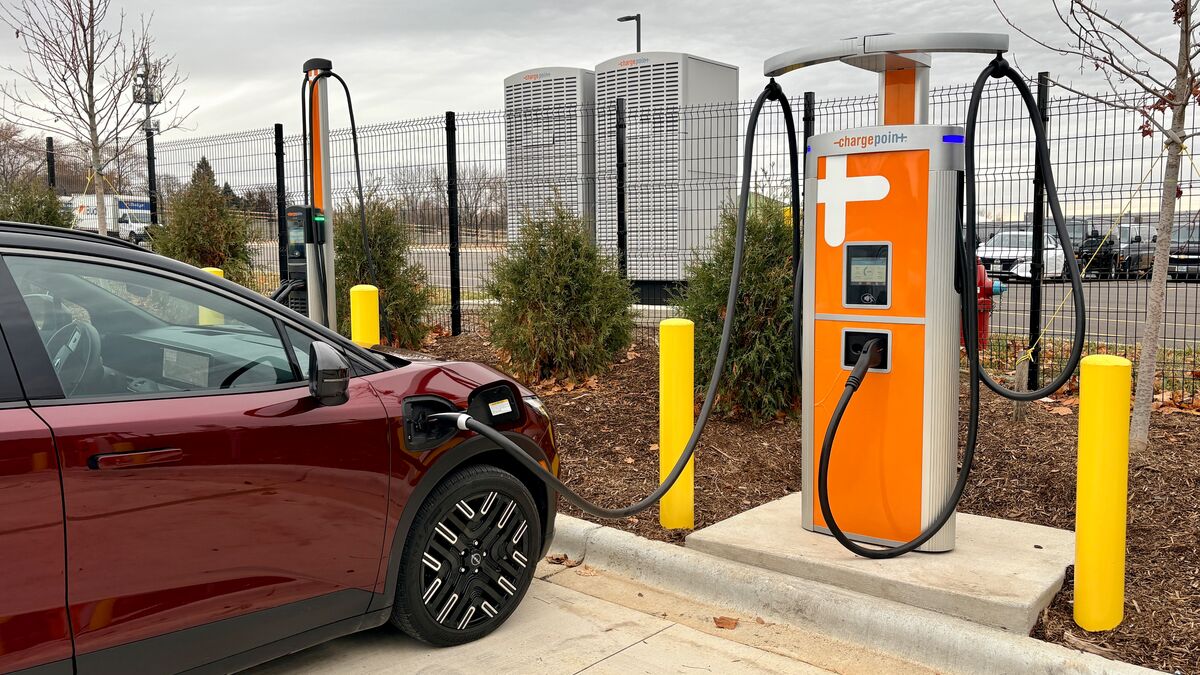
Electric vehicles (EVs) can be an excellent option for drivers, offering both environmental benefits and lower fuel and maintenance costs. Electric car batteries have improved significantly in recent years, and today’s EVs easily handle most daily driving needs. While electric cars have many advantages, their driving range can still be a concern compared with that of traditional gasoline-powered engines. Drivers who find that even the longest-range electric cars do not meet their needs still have other options. Anyone concerned about range anxiety may want to consider partial electrification through a plug-in hybrid vehicle (PHEV), which combines an electric battery with a traditional gasoline engine to extend driving range.
RELATED: An EV Charger Buying Guide: See All Your Options
Electric Car Range
Longest EV Ranges By Year
Electric cars receive EPA ratings that estimate how far they can travel before the battery is depleted. Unlike gas-powered cars, which often exceed their EPA fuel economy estimates, EVs typically fall short of their EPA combined range estimates in real-world driving. EVs tend to perform efficiently in stop-and-go traffic because regenerative braking helps recover energy. However, they use significantly more battery power at higher highway speeds and during extended trips. Some models are better suited to long-distance travel than others, so it is important to understand your driving needs before purchasing a new EV.
Vehicles like the 2026 Nissan Leaf S+, which can reach up to 303 miles, are better candidates for shorter commutes and in-town errands. For road trips and extended travel, longer-range EVs such as the 2026 Lucid Air Grand Touring, which offers up to 512 miles on a single charge, might be a better fit. There also are plenty of in-between options.
If you don’t have access to an at-home charger, you’ll need to explore other nearby charging options. Being aware of your charging options can also benefit you if you’re planning any future long-distance road trips. According to the U.S. Department of Energy’s Alternative Fuels Data Center, as of April 2026, around 85,000 charging stations are located across the United States. These stations have a combined total of more than 276,000 charging outlets. While this number continues to grow rapidly, traditional gas pumps still far outnumber electric charging options, and public charging is scarce in some regions.
RELATED INFOGRAPHIC: Longest EV Ranges by Year
Charging Options
To understand EV charging, you’ll want to understand terms like kilowatt-hours (kWh) and kilowatts (kW). A simplified — very simplified — way to think of these terms is that kWh is like talking about the size of a car’s gas tank, while kW is like talking about a car’s horsepower. A fully electric car needs energy from the battery to run the motor. Battery capacity is measured in kWh. Motor output is measured in kW.
When comparing charging options, it’s helpful to evaluate charging speeds by the number of miles of range added per minute or hour of charging.
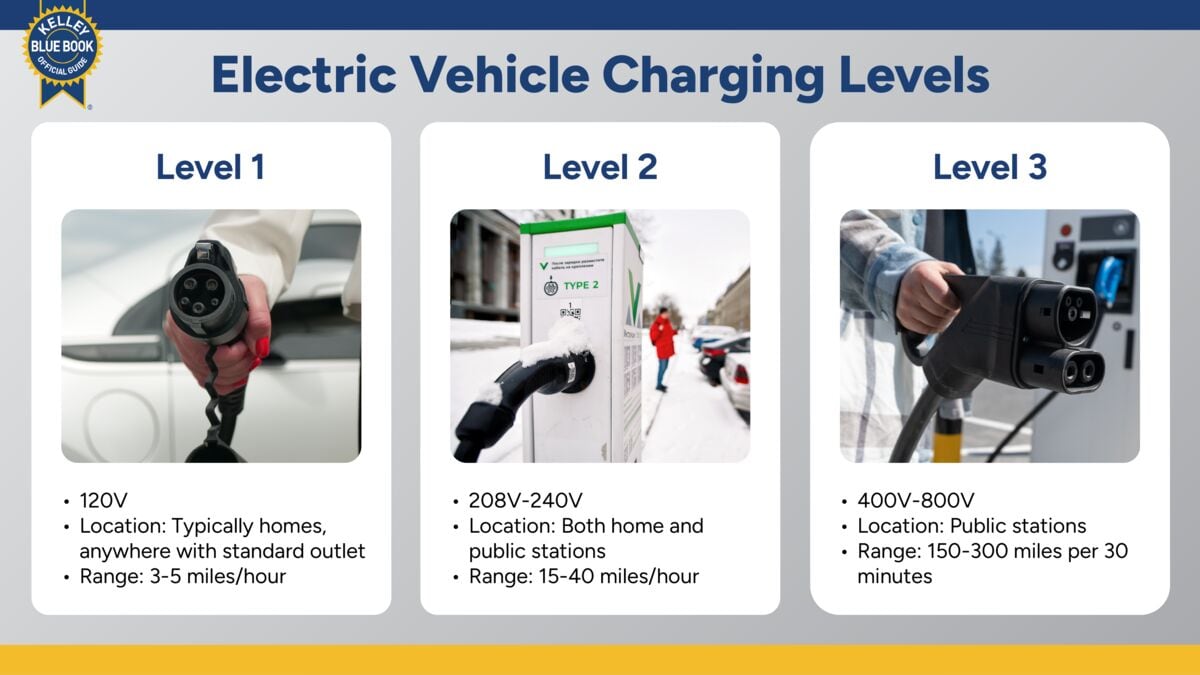
- Level 1: This is the slowest charging method and typically uses a standard 120-volt household outlet, providing about 5 miles of range per hour. Although Level 1 chargers are convenient for overnight home charging, they are uncommon at public charging stations.
- Level 2: This charging method operates on a 240-volt circuit and is commonly available at public charging stations. It can add about 35 miles or more of range per hour, depending on the vehicle and charger.
- Level 3: Also known as DC fast charging, Level 3 chargers can deliver a large amount of power directly to an EV battery. Many newer EVs can charge from nearly empty to about 80% in as little as 30 minutes with a Level 3 charger.
RELATED: What to Look for When Buying an Electric Car in 2026
Plug-In Hybrid Electric Vehicle
If you are not convinced that an all-electric vehicle is right for you, a plug-in hybrid electric vehicle (PHEV) may be worth considering. Unlike conventional hybrids, PHEVs have larger battery packs, which make them more similar to fully electric vehicles in day-to-day use. Their batteries typically support about 25 miles of electric-only driving. For example, a commuter with a 20-mile one-way trip and access to workplace charging could complete daily driving with little or no gasoline use. If the vehicle is driven primarily on battery power, the gas engine may still cycle on occasionally to prevent fuel in the tank from going stale.
Plug-in hybrids also charge more quickly than all-electric vehicles because their batteries are smaller. On longer trips, drivers can stop at public charging stations to recharge the battery and reduce gasoline use. Many newer plug-in hybrids also allow drivers to reserve electric charge for later use. For example, a driver might choose to use battery power only on local roads, where it is generally more efficient than at highway speeds.
Editor’s Note: We have updated this article since its initial publication.