


Overview
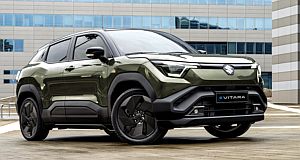
Suzuki has launched two electrified SUVs in Australia, both wearing the long-running Vitara nameplate. The Vitara Turbo Hybrid replaces the internal combustion-only model while the e Vitara – scheduled for arrival in Australian dealerships in June – is the brand’s first battery electric vehicle.
However, despite having the same name, Suzuki’s new Vitara stablemates are actually two completely different vehicles, built on two different platforms, in two different factories, and each sporting unique interior and exterior designs.
Two variants of the Vitara Turbo Hybrid are being offered in Australia. The two-wheel drive (FWD) version starts at $39,990 drive-away, while the all-wheel-drive Vitara Turbo Hybrid Allgrip comes in at $45,990 drive-away.
This pricing places it in competition with the likes of the Hyundai Kona Hybrid ($36,950 – $48,950 before on-road costs) and the Toyota Yaris Cross ($31,790 – $39,930 + ORCs).
Unlike its Toyota and Hyundai rivals and despite being badged as a ‘Hybrid’, the new model actually adds a 48-volt mild-hybrid system to the current generation Vitara which was first introduced Down Under in 2015.
Its powertrain consists of a 1.4-litre turbocharged four-cylinder engine, an electric motor sourcing power from a lithium-ion battery, and a six-speed automatic transmission, good for a combined system output of 80.9kW and 235Nm.
According to Suzuki, the mild-hybrid system operates during take-off and acceleration while recharging through regenerative braking.
While power drops compared to the outgoing petrol-only Vitara Turbo (down from 103kW), torque has increased by 15Nm from 220Nm.
Compared to their predecessors, fuel economy has improved by 0.1L/100km and 0.3L/100km in the FWD and AWD models respectively.
As standard, the FWD Vitara Turbo Hybrid arrives with 17-inch alloy wheels, LED headlights and daytime running lights, a 7.0-inch infotainment touchscreen, a 4.2-inch digital display contained within the gauge cluster, an auto-dimming rearview mirror, rear privacy glass, a leather-wrapped steering wheel, fabric seats, automatic air conditioning, and a four-speaker sound system.
The standard safety suite includes a rearview camera, adaptive cruise control, lane departure warning, lane keep assist, rear cross traffic alert, blind spot monitoring, traffic sign recognition, and Suzuki’s dual brake support II system. However, the updated Vitara Hybrid remains unrated by ANCAP.
Aside from the all-wheel drive system, the Allgrip adds a 9.0-inch infotainment screen, a panoramic sunroof, four drive modes (Auto, Sport, Snow, and Lock), a nine-speaker sound system, and synthetic leather upholstery.
Suzuki quotes 362 litres of boot space for the Vitara Turbo Hybrid with all seats upright, 642 litres with the rear seats folded and a maximum cargo volume of 1119 litres.
As for the e Vitara, two variants will be offered locally: the entry-level 49kWh Motion and the 61kWh Ultra model.
The Motion model pairs a 49kWh lithium ion battery with a front-mounted electric motor producing 106kW and 193Nm. It has a claimed energy consumption of 14.9kWh per 100km and a WLTP driving range of 344km.
In the Ultra variant, the battery capacity is increased to 61kWh and the dual-motor, all-wheel drive powertrain produces 135kW and 307Nm. Energy consumption is quoted at 16.6kWh per 100km, with a WLTP range of 395km.
The e Vitara supports 7kW AC single-phase and 11kW AC 3-phase charging. It also supports DC rapid charging, allowing 10 to 80 per cent charges to be completed in 45 minutes.
Suzuki is yet to officially confirm Australian pricing for the e Vitara, but suggests that it will sit somewhere between the BYD ATTO 3 ($39,990 – $44,990 + ORCs) and the Kia EV3 ($47,600 – $63,950 + ORCs).
As standard, the 49kWh Motion model gets 18-inch alloy wheels, a 10.25-inch digital instrument cluster, a 10.1-inch infotainment touchscreen with Apple CarPlay and Android Auto, three driving modes (Eco, Normal, and Sport), a leather-wrapped steering wheel, fabric seats, manually adjustable front seats, adjustable rear seats, 12-colour ambient lighting, and a four-speaker sound system.
Standard safety features include adaptive cruise control, traffic sign recognition, lane keep assist, lane departure prevention, dual brake sensor support II, high beam assist, rear cross traffic alert, a 360-degree camera, and front and rear parking sensors. While the e Vitara is currently unrated by ANCAP, it received a four-star score from its sister independent safety body Euro NCAP.
The Ultra model adds fabric and synthetic leather seats, a 10-way electrically adjustable driver’s seat, heated front seats, wireless phone charging, an Infinity sound system, a glass roof with a retractable sunshade, adaptive high beam assist, and hill descent control.
Suzuki quotes 244 litres of boot space with rear seats up, extending to 310 litres with the rear bench moved forward, and 562 litres with the rear seats folded.
The Vitara Hybrid comes with a five year, unlimited kilometre warranty and five years of roadside assist.
It is also available with a five-year, 100,000km service plan, with intervals coming every 12 months or 10,000km, with the total cost amounting to $1985.
As of the time of writing, Suzuki is yet to confirm the warranty, roadside assist and servicing package for the e Vitara.
Driving Impressions
Our on-road drive time with the Vitara Hybrid and e Vitara was extremely limited, with the test route primarily consisting of the single carriageways and urban streets around Sydney Motorsport Park.
Specifically, GoAuto got to experience the Vitara Turbo Hybrid Allgrip and the two-wheel drive 49kWh e Vitara Motion, which – despite sharing a nameplate – each offered extremely different experiences.
Stepping into the cabin of the Vitara Hybrid unsurprisingly feels like stepping back into the mid-2010s, as this interior remains largely unchanged since the current-generation model’s introduction back in 2015. However, despite how dated it feels, it’s still functional.
The physical controls for the air conditioning, window demisting, and air recycling are close at hand. The 9.0-inch infotainment touchscreen, while fairly basic, is easy to navigate (although, having briefly tested it, the 7-inch unit in the FWD model is a bit too clunky and dated).
Visibility is also strong, with large front and rear windows and relatively thin a-pillars aiding in forward visibility.
The cabin’s material quality is hardly Rolls-Royce rivalling but the immediate touchpoints – particularly the leather-wrapped steering wheel – feel pleasant, and it doesn’t feel cheap and nasty. The build quality is also solid, with no untoward squeaks or rattles.
It feels a little tight and slightly spartan in the back seat, with not much rear legroom, average headroom, and no rear air vents, centre folding armrest or charging amenities.
On the road, the Vitara Hybrid’s handling surprised us. Before driving it on the road, the Vitara Hybrid had proven its agility and solid body control through a slalom course, which also translated in the ‘real world.’
Take a corner with exuberance – for instance – and the Vitara keeps it tidy. It won’t wash wide, the body stays fairly level, and you won’t hear undue tyre squeal.
The steering is also light, yet precise, a suitable tune for the urban environments in which most Vitara Hybrid examples are likely to spend their lives.
When it comes to refinement, the rest of the experience is perfectly acceptable for a vehicle of this price. The ride reveals harsher bumps but it’s still comfortable. There’s a bit of tyre noise while on the move, but not to the point of being offensive.
While the powertrain of the Vitara Hybrid is touted as its headline feature, it doesn’t set the world on fire. The engine and transmission package isn’t always the slickest, occasionally feeling slightly unresponsive.
Its performance figures are far from earth shattering, but it still has enough grunt that it doesn’t feel underpowered.
Our drive time was perhaps slightly too short to record meaningful fuel economy data, but the trip computer returned 6.3 litres per 100km.
ADAS calibration is solid, with sensible lane centring intervention and no unnecessary beeps and bongs.
Compared to its stablemate, the e Vitara feels much more modern and delivers a more refined experience.
Its cabin feels current and actually quite premium, with plush materials, a two-spoke steering wheel and a minimalist dashboard with a cleared-out storage space beneath it. However, Suzuki has perhaps gone a little too heavy with the piano black plastic trim on the centre console.
The dual displays appear crisp with a simple, well-laid out interface that makes finding key functions easy. Usability is also aided by physical switches for the air conditioning, window demisting, and air recycling, as well as a physical media volume knob.
As for the back seat, legroom is extremely impressive, headroom is ok, although under-thigh support is slightly lacking on the rear bench. Rear seat passengers also get a USB-C charging port, rear air vents and a centre folding armrest with cupholders.
However, the e Vitara’s boot space (244/310L/562L) is a little small compared to some of its expected rivals such as the BYD ATTO 3 (440L/1340L) and the Kia EV3 (460L with rear seats up + 25L frunk).
Compared to its mild-hybrid stablemate, the e Vitara’s handling is a less impressive affair. It has a tendency to understeer, has noticeable body roll, and its 1700kg kerb weight is certainly noticeable. By no means is it deficient for daily driving, though. The steering is still precise but can’t quite match that of the Vitara Hybrid.
What the e Vitara brings to the table is comfort and refinement. The ride is soft without feeling underdamped. It’s also incredibly quiet while on the move, and we didn’t notice much in the way of tyre, wind, or road noise.
As for the electric powertrain, there’s an ever-so-slight delay when you go for the throttle, but even in the entry-level single motor variant, the e Vitara is certainly brisk. Unfortunately, we didn’t have the opportunity to drive the e Vitara long enough to record meaningful range data.
The e Vitara’s ADAS calibration feels similarly non-intrusive to its Hybrid stablemate with no excessive beeping, bonging or untoward interventions.
Overall, the Vitara Hybrid is surprisingly enjoyable to drive for a small SUV but arguably suffers from a dated interior and a price tag that’s too close to full hybrid rivals such as the Hyundai Kona Hybrid and the Toyota Yaris Cross Hybrid without the fuel economy to boot.
As for the e Vitara, it offers an impressively comfortable, refined experience and marks what appears to be a relatively strong first foray into electric vehicles for Suzuki. However, we’re yet to see what extended testing yields in terms of real-world range and with Australian pricing unconfirmed, its true place in the EV market remains to be seen.