

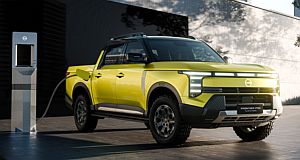

NISSAN is planning to muscle in on the growing electrified ute segment with the Frontier Pro plug-in hybrid shaping as a pivotal model in its response to tightening emissions rules and a rapidly shifting market.
While not yet formally locked in for Australia, the Chinese-made dual-cab is widely expected to join the just-arrived new Navara in local showrooms – and it could even wear a Navara badge.
Australia’s New Vehicle Efficiency Standard (NVES) is already reshaping product plans across the industry, forcing brands to reduce fleet-wide emissions or face financial penalties. For utes – traditionally powered by diesel – that presents a particular challenge.
But a recent wave of electrified rivals has laid the groundwork for hybrids that team an engine (typically petrol-powered) with an electric motor or two.
They include the BYD Shark 6, GWM Cannon Alpha PHEV and Ford Ranger PHEV, with more on the way from brands such as Geely, JAC and Chery, the latter set to make waves with a diesel hybrid set-up.
The result is a clear shift: the once diesel-dominated ute segment is cautiously embracing plug-in hybrid power.
Little wonder Nissan wants in on the action, with soon-to-depart Nissan Oceania managing director Andrew Humberstone suggesting the Frontier Pro could play a leading role, while also allowing the just-arrived D27 Navara – essentially a rebadged Mitsubishi Triton – to appeal to the Nissan faithful.
“We have JVs with Dongfeng, we have JVs with Renault, we have JVs with Mitsubishi – we have options,” he said when questioned about where Nissan could source a hybrid ute.
At the same time he ruled out a hybrid version of the D27.
“For us, it’s about what makes sense and what serves our market, that provides us with that technology.”
It also appears the Frontier Pro could at least in some way leverage the Navara name.
“If you’re still running Navara, then is that a Frontier?” Humberstone said. “Or if you’re not running a Navara, is it a Navara? You’re probably running them parallel. So do you have a Navara and a Frontier?”
He hinted that the naming question would be answered within a couple of months.
Then there’s how such a radical new model would be positioned, something that looks set to create a split strategy for Nissan.
“You’ve got the hardcore ute driver… and you’ve got the other who maybe wants to take their dogs to the beach,” Humberstone said.
“They have different requirements. So are we able to cater for both?”
Wherever it sits, the Frontier Pro is an important step in the ute segment for Nissan.
Plug-in hybrid utes are emerging as a crucial stepping stone between traditional diesel workhorses and full electric vehicles, offering lower emissions without sacrificing towing, range or refuelling convenience.
For Nissan, the Frontier Pro represents a chance to quickly close that gap.
The model has been developed with joint-venture partner Dongfeng and is effectively a twin to the Chinese-market Z9, sitting on a ladder-frame platform with independent suspension up front and a live axle at the rear.
Under the skin, the Frontier Pro combines a 1.5-litre turbocharged four-cylinder petrol engine with an electric motor, delivering a combined output of around 320kW and 800Nm.
That’s significantly more than the circa-150kW/500Nm common in the diesel ute world.
Crucially, the Frontier Pro can drive purely on electricity, utilising its 32.9kWh battery for 135km of claimed EV range, at least according to the optimistic CLTC Chinese standard (expect less in the real world).
Throw in the petrol tank and the Frontier Pro is claimed to travel more than 1000km.
If it can get close to the high equipment levels and sharp pricing of the hybrid utes already in the market it’s easy to see the potential.
With more rivals on the way – as well as full battery electric versions of the Toyota Hilux and Isuzu D-Max – the window to respond is narrowing.
For Nissan, if the Frontier Pro lands in Australia – and all signs suggest it will – it’s set to mark the beginning of a very different era for Nissan utes, and for Nissan’s place in the country’s most hotly contested market.
-ends-
Document footer info
Add at least three if possible, separated by a carriage return or comma as per the below example.